.webp)
Key Takeaways:
- Your financial habits have a pattern and it maps to one of four money personalities.
- Money decisions get clearer once you know your financial archetype.
- Everyone has blind spots and foundational fixes that address them directly.
- Knowing your money personality is the first step toward making smarter financial decisions.
- Four money mindsets, four financial gaps, four concrete starting points.
An unexamined financial habit will cost you more than any splurge ever will.
Nobody sits down one day and decides to leave money on the table. It happens in the small, consistent, completely unconscious ways we make financial decisions. It’s the split-second hesitation before hitting "add to cart", the salary number we say out loud versus the one we actually wanted, or the bold pivot that worked brilliantly — right up until the moment you realized there was no plan B.
Your money mindset is the pattern underneath all of it. And once you see it, you genuinely can’t unsee it.
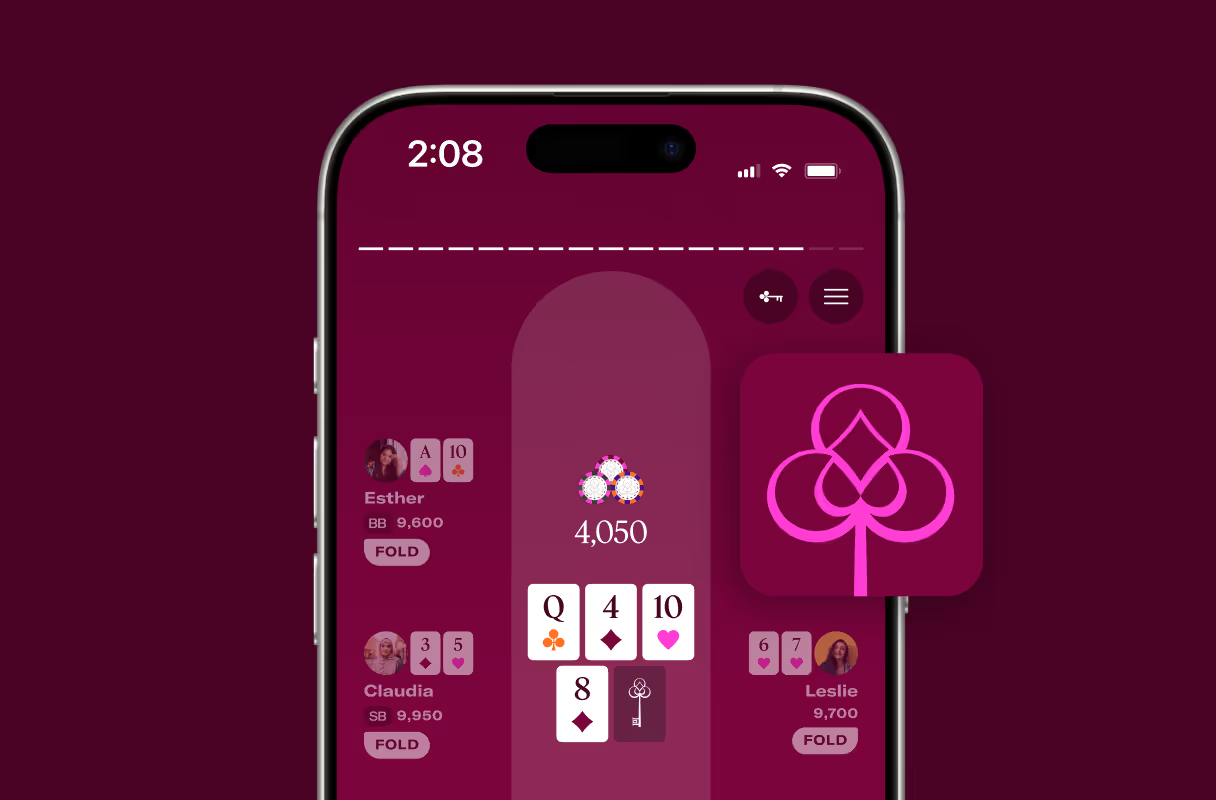
The Power Suit Quiz is our version of a personality quiz. It identifies exactly which pattern is running your strategic mindset, even when it comes to money. Four suits. Four completely distinct ways of navigating decisions.
♠ The Strategist: Brilliant at Research. Allergic to Commitment.
There’s a version of financial preparedness that is actually just very sophisticated procrastination. The Strategist has perfected it.
They know the difference between a Roth IRA and a traditional IRA and could explain dollar-cost averaging at a cocktail party and actually make it sound chic. What they haven’t done is move the money they’ve been "about to invest" for the better part of two years.
The logic is seductive: the next data point will finally provide the certainty they need. Meanwhile, compounding interest is doing its thing for everyone who moved on imperfect information.
A deadline is more useful here than another research tab. The Strategist already has everything they need to move.
Start here → How to Start Investing
♣ The Initiator: Moves Fast, Lands Hard, Figures Out the Net Later.
The Initiator has a rare gift: they can walk into a room with nothing but an idea and walk out with a signed contract. They bet on themselves before the evidence is in, and they win often enough that their strategy feels solid.
But something’s missing: a safety net. That’s what makes their wins sustainable.
When you're wired for forward motion, financial infrastructure sounds like a conversation for people who aren't as good at figuring things out on the fly. Emergency fund? Sure, eventually. The problem with that is it tends to arrive at the exact moment you can least afford it.
What makes the Initiator's boldest moves land are the financial cushions that turn a great swing into a repeatable strategy.
Start here → How to Build an Emergency Fund
♥ The Connector: Knows Everyone Else’s Worth.
The Connector can breeze into a negotiation and instantly read every person at the table — their hesitation, their flexibility, the real number hidden behind an opening offer. Genuinely one of the most strategically gifted people in the room.
Too bad so many of their negotiations are on behalf of others.
Theirs is a particular kind of financial self-sabotage that doesn't look like self-sabotage at all. It looks like being reasonable. Like not wanting to make things weird. Deciding that the relationship is worth more than the raise. Is it true? Sometimes. Or maybe it’s just a very compelling story to avoid an uncomfortable conversation.
The Connector's financial turning point is the moment they realize the table's been waiting for them to play their own hand.
Start here → How to Negotiate Your Salary
♦ The Executor: Wins the Game. Sometimes Forgets to Protect It.
The Executor moves at a speed that makes most financial checklists feel irrelevant. By the time the list says "consider opening a savings account," the Executor has already negotiated a raise, maxed a contribution, and moved on to their next financial goal.
Yet the foundational moves have a way of getting skipped, not from carelessness, but from momentum. They're so focused on the next hand they may forget to protect their stack.
A budget is the foundation the Executor keeps meaning to build — and the one that pays off most when they finally do.
Start here → How to Budget for Buying a Home
One of These Is You. Probably More Than You'd Like to Admit.
The suit that made you pause a little too long, the description that felt like it was written about you — that's your read. Trust it.
Knowing your pattern is the move that makes every other move smarter.
Think you already know your suit? Prove it. Take the Power Suit Quiz.

FREE DOWNLOAD
Read Our Confidence Guide
By proceeding you consent to receive marketing communications (such as newsletters, blog posts, webinars, event invitations, and new product updates), and targeted advertising from Poker Power from time to time. You can unsubscribe from our marketing emails at any time by clicking on the "Unsubscribe" link at the bottom of our emails. For more information on how we process your personal information and what rights you have in this respect, please see our Privacy Policy and Terms of Service.